
The Weekend I Outplayed My Boss
He left the bait. I took it. And I learned what moxie really means.


I have an odd relationship with Lost in Yonkers.
Every few years I put it on again for reasons I can’t quite explain. It’s Neil Simon—you already know what you’re getting. A little too neat, a little too clever, but when you’re in the right mood, it lands perfectly. The rhythm, the timing, that faint ache of honesty that hides inside all his comedy.
And of course, there’s that line—the one that escaped the film and wandered into popular culture:
“You got moxie, kid.”
Everyone’s heard it, even if they couldn’t tell you where it came from.
For years, I never really understood it. It always sounded like something your uncle would say after you changed a tire. “You got moxie, kid.” Sure. Okay.
But there’s this moment in the movie—set in the dining room. Artie, the nephew, says to his uncle, “What’s moxie?”
And Dreyfuss puts down his bag, walks over, rolls up his sleeves, shifts his stance, gives a little head tilt and shoulder pop—almost a come and get it kind of look—and says,
“That’s moxie.”
And at the end, after everything’s gone sideways and somehow right again, he’s driving off into the night, calling back to that same boy who’s just stood his ground against the mobsters:
“You got moxie, kid!”
That’s when it hits you.
Moxie isn’t swagger.
It’s the decision to face what might eat you alive—because standing still would kill you slower.
Early in my career, I was working at a production company that, for reasons above my pay grade, was already half-doomed.
It was the end of the line for me there. The air had gone sour with one of the executive producers—whom I may or may not have written about before—and I was quietly plotting my exit.
My direct boss, though, was the opposite. The kind of man you never forget. A little bouncy, a little old-school, the kind who printed out every email he ever got. I think he just liked something he could hold. It made sense to him.
I was already the kind of person who gave up weekends for “special projects.”
Young, eager to prove myself, eager to please—that was just who I was back then. I was probably twenty-five, maybe twenty-six, trying to get my first real post-supervisor job.
So I was in on most weekends, tinkering, trying to get noticed.
That’s when I saw it: an email printed out and left on his desk.
“We need someone young and eager. The pay’s not great.”
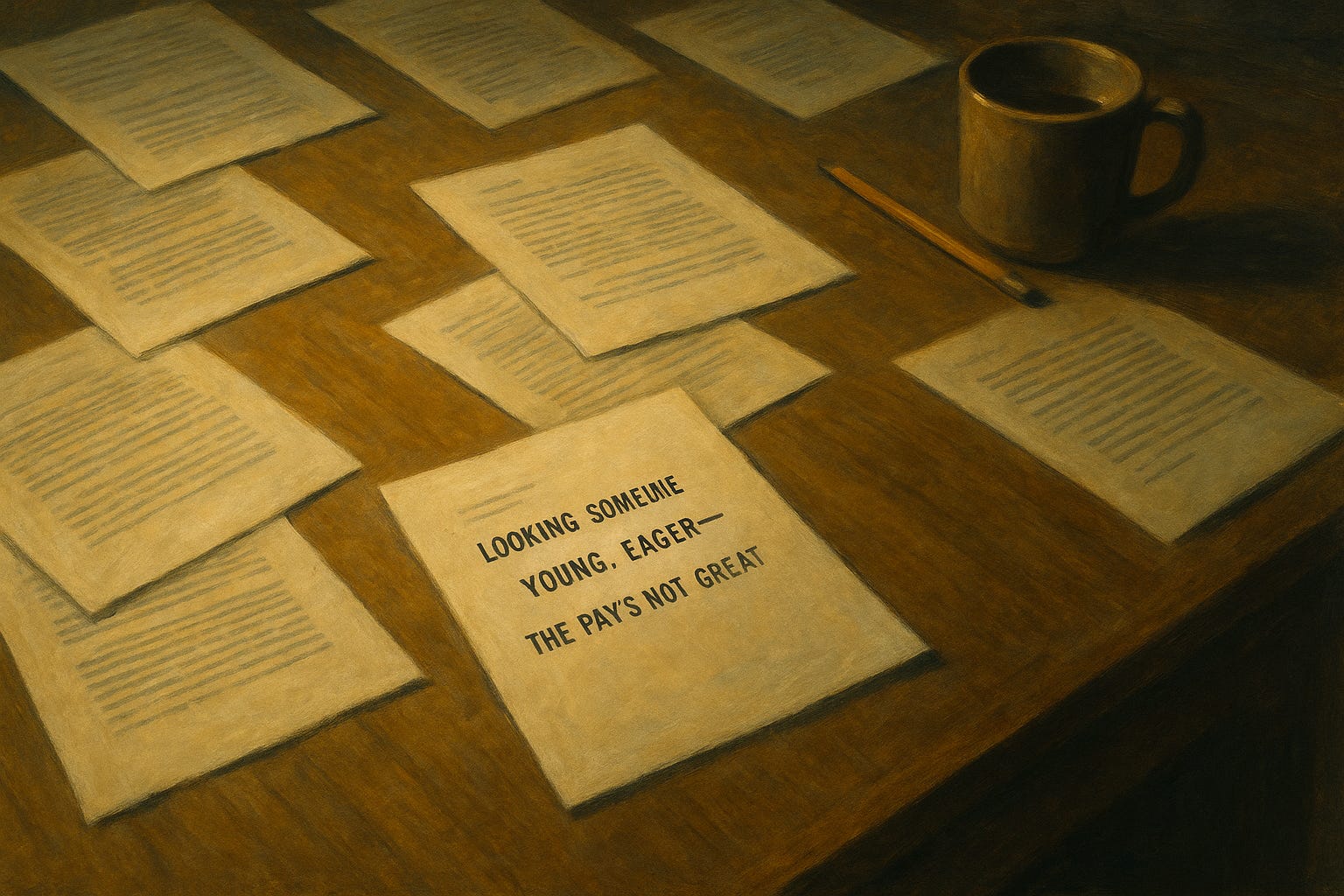
I recognized the name of the person who’d written it—a producer who was known for working on weekends. He’d usually ask how to get into a project, or how to get access to some drive. And I’d always say, Don’t worry about it, I’ll be there, I’ll take care of it.
So when I saw that email, I waited to hear which weekend he’d be in again. When he mentioned it, I said, “No problem, I’ll cover.”
But I wasn’t covering. I was planning.
I structured the whole day around that meeting. I didn’t want to look like I’d been waiting.
I let him come in, get comfortable, settle into his rhythm.
Then I established mine—back and forth, in and out of the server room, down the hall, back again. Just a regular pattern, nothing sudden.
I wanted him to see me as part of the environment. Background. Expected.
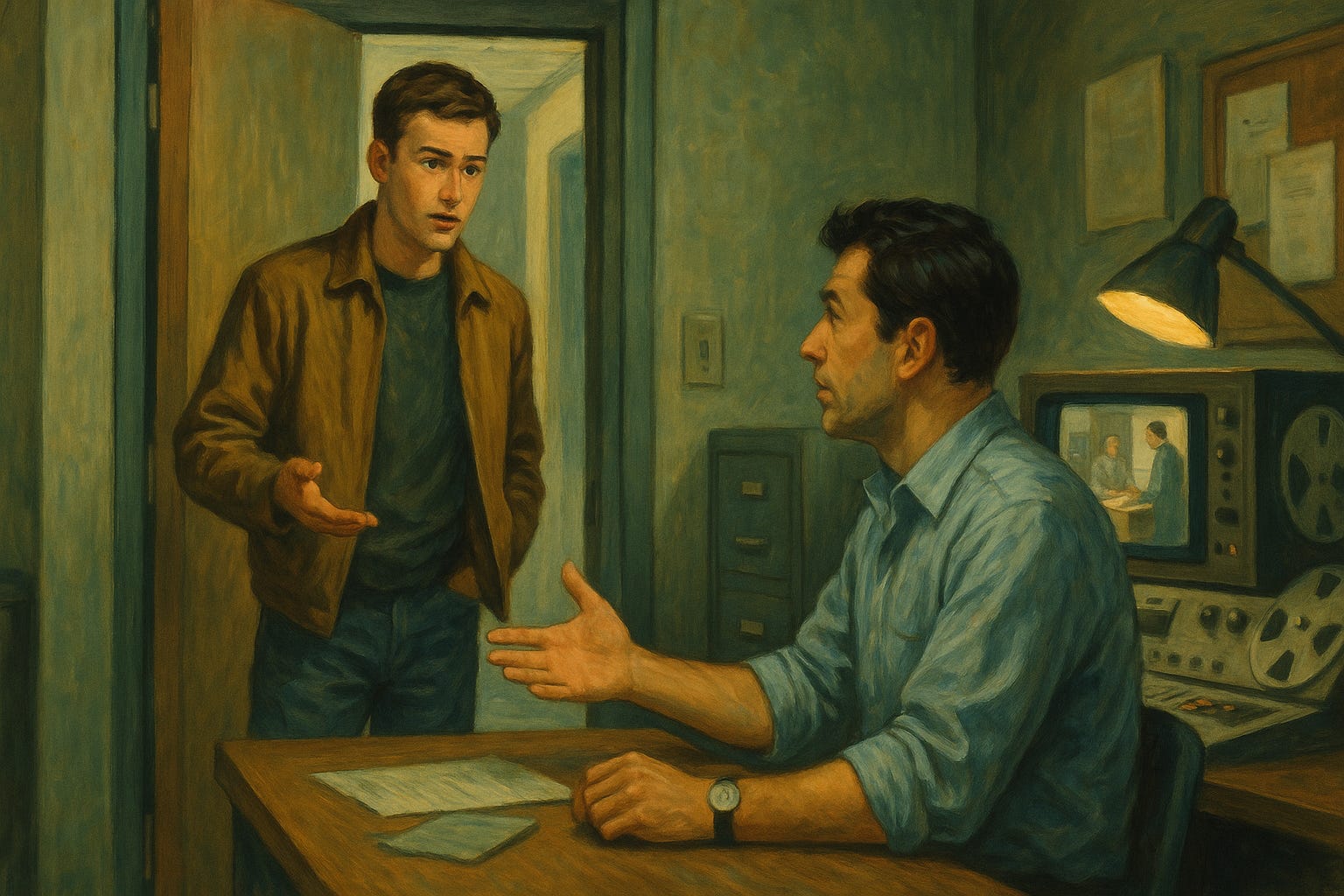
And right around lunchtime, the bay door of his edit room was open. I walked by on one of my “rounds,” did a little swing-by, stopped, turned, leaned into the doorway, and said,
“Hey.”
He looked up.
That’s when I asked,
“How do you think someone gets their first post-supervisor job when they think they’re ready?”
That was it. No pitch. No résumé. Just the right question, dropped in the right ear.
He paused, thought for a second, and said, “You know, I might know someone.”
A two weeks later, I was gone—off to my first big supervising job.
Just before I left—maybe the day after I resigned—my boss came by my desk, smiling.
“So,” he said, “you read the email on my desk.”
That’s when it hit me.
He’d known the entire time. He’d left it there for me.
He gave me the permission I didn’t know I was waiting for.
That’s moxie.
Not arrogance. Not manipulation. Just the nerve to act when the universe leaves the door cracked open—and the grace to thank the person who left it that way.
At the time I didn’t think of it as moxie. I just thought it was guts—balls, really.
But maybe that’s the same thing, just wearing a younger man’s face.
Lost in Yonkers ends the way all Neil Simon stories do—half-hope, half-ache.
That’s what moxie really feels like. Not triumph, just survival with some style.
When I think back, I realize I didn’t have experience or capital or certainty. I had moxie—the calm conviction that I could figure it out, even if I had to invent the way as I went.
So maybe moxie isn’t attitude after all.
Maybe it’s moral physics—momentum with a soul.
“You got moxie, kid.”
Yeah. Maybe I finally do understand what that means.
