
Everything I Needed to Know About AI, I Learned from Walt Disney in 1964
Walt Disney built machines to end drudgery. The future depends on whether we learn to use ours the same way.

I was watching The Studio on Apple TV the other night, a few hours after the news broke that Catherine O’Hara had passed away. The timing felt uncomfortably precise. I’ve been watching O’Hara my entire life. She spent it playing women who understood the performance even as they were trapped inside it — characters sharper than the worlds that needed them, often reduced to spectacle anyway. I’ll never forget how exact her comedy always felt. The timing, the control, the sense that every gesture was chosen. Even at her broadest, she made the work feel deliberate, as though the joke itself knew more than it was letting on.
The Studio operates in that same register. Recently renewed, it treats modern Hollywood as a system that keeps mistaking continuation for survival. It’s a love letter wrapped in satire, a peek behind the curtain of an industry that keeps trying to resuscitate itself through noise, leverage, and denial.
Bryan Cranston plays the studio head, a man who cares nothing for art and everything for outcome. He’s the embodiment of a machine that confuses activity with vitality — endlessly reassuring itself that profit is proof of life.
In the episode, the studio is hosting its big upfronts — that yearly ritual when distributors and theater owners gather to be sold on the new slate of movies.
It’s a circus, but a joyful one.
Movie stars crowd the stage, trailers play in perfect rhythm, speeches swell with just the right amount of hope.
The audience isn’t faking it; they’re having fun.
For a few minutes, everyone remembers why they came into this business in the first place.
And that’s when I hear it, tucked behind the raucous applause: a melody that pulls me straight out of the moment.
My ear perks up like a reflex. What is that?
The rhythm is impossible to mistake. Is it?
And then I laugh, quietly but audibly. Oh my God, it is.
Followed by the inevitable realization: Oh my God, this must be so expensive.
“There’s a Great Big Beautiful Tomorrow…”
They chose it because it fits.
The characters have just pulled off something improbable, and the song seals it — an anthem for survival disguised as a jingle about optimism. For a brief moment, everyone in that fictional theater believes again: that movies still matter, that audiences will still show up, that creativity isn’t dead yet.
The optimism is unbreakable.
The future is assumed.
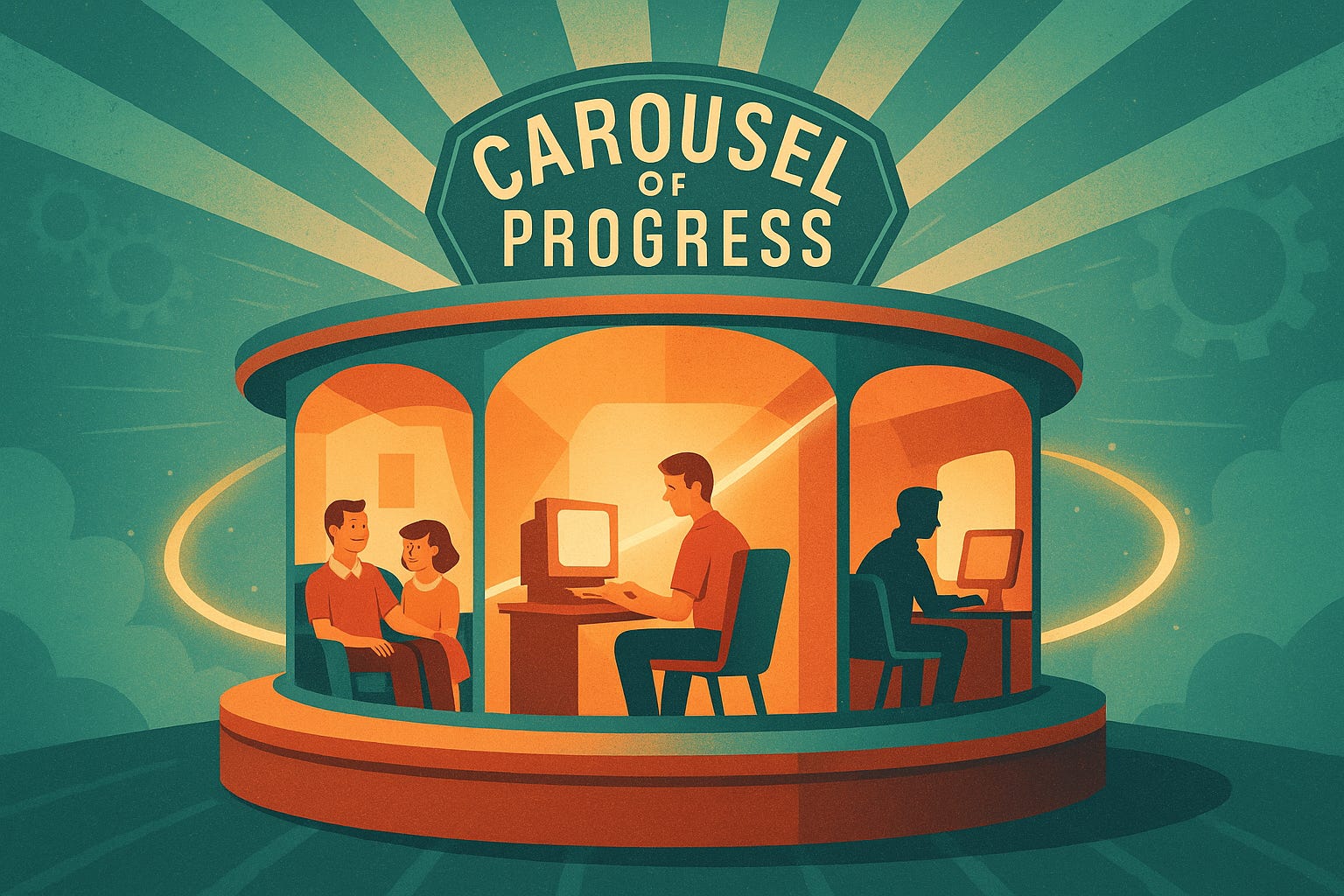
The Carousel of Progress
Walt Disney’s 1964 love letter to automation — the ride he designed for the World’s Fair, later moved to Disneyland.
A rotating theater, one family living through each new age of invention: the electric age, the jet age, the imagined home of the year 2000. The family never changes; they simply move forward through time, learning, adapting, smiling.
The optimism is unbreakable.
The future is assumed.
That song, as earnest as it sounds, wasn’t written as propaganda. It was a declaration of faith.
Walt believed automation could end drudgery, not work.
He believed that progress was supposed to buy people back their hours — to relieve them from the mechanical and monotonous so they could spend more of life on what makes it worth living.
Machines, in his mind, were meant to be servants of imagination, not substitutes for it.
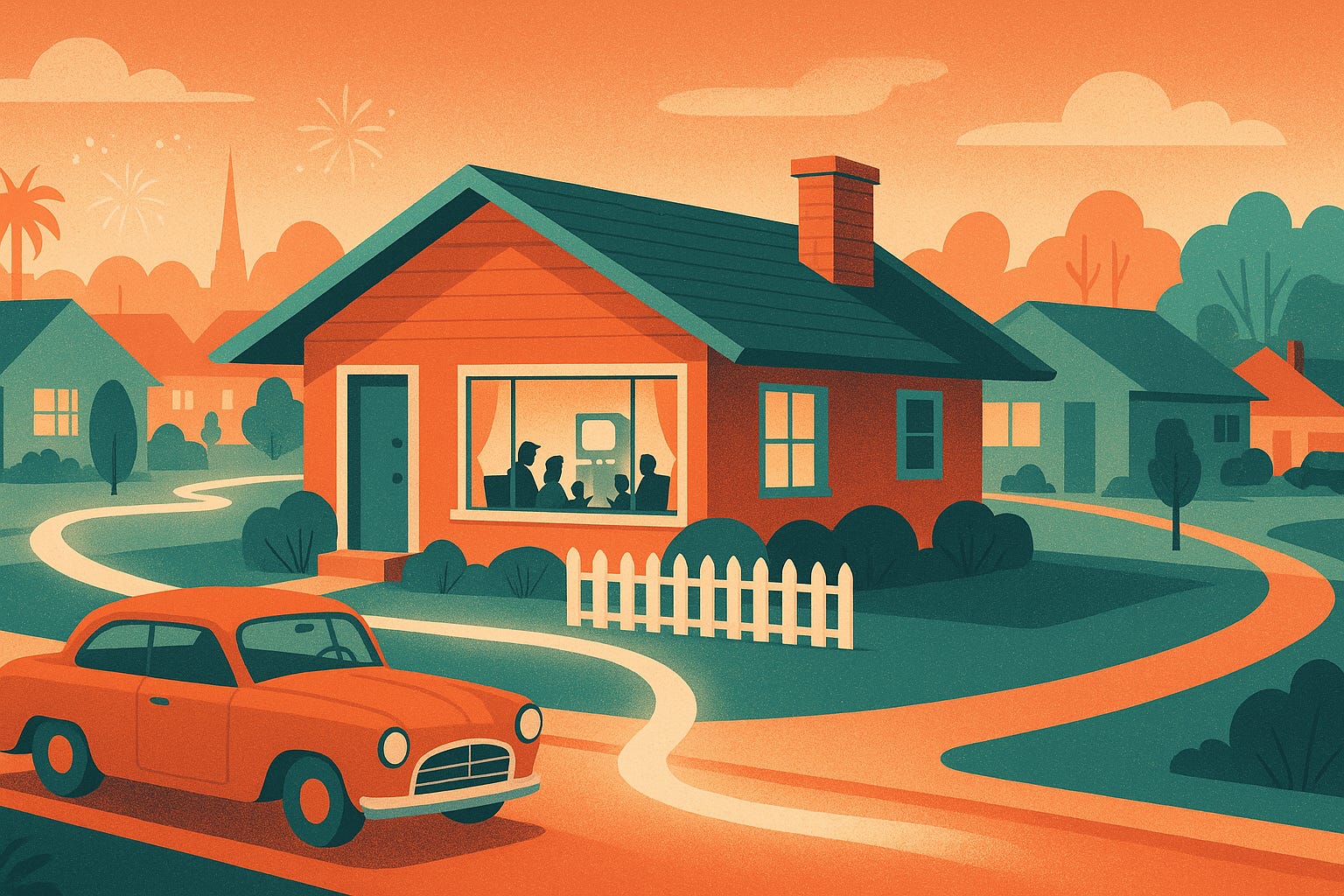
He was a capitalist and a complicated one — anti-union, obsessive, ruthless about his standards — but he understood reciprocity. His dream depended on a middle class healthy enough to afford leisure, to take a week off, to buy a ticket to the future he was selling.
He knew you can’t sell wonder to people who can’t afford rest.

That’s what made Carousel of Progress so powerful — it wasn’t just optimism, it was also a promise.
Progress was circular: technology lightened the load, people had time to dream, those dreams created new industries, and the circle began again.
And audiences back then understood that promise. They didn’t fear the machinery; they believed it was there to serve them.
You can see that in Pirates of the Caribbean, the other attraction Walt was building near the end of his life. Those animatronic pirates — rowdy, singing, endlessly repeating their scenes — weren’t a cost-cutting trick.
Walt didn’t automate because he didn’t want to pay performers; he automated because he knew no human could keep that rhythm forever. The actors would tire, their voices would crack, the energy would fade.
The pirates were never meant to replace people — they were built to hold the repetition so that people could stay inventive.
Automation, in Walt’s hands, was an endurance strategy for creativity.
Nobody complained that the pirates had been replaced.
Everyone understood the difference between drudgery and artistry, between the endless motion of work and the human spark of making something new.
That’s the part we’ve lost.
Somewhere between the optimism of Carousel and the automation of today, progress stopped circling back.
We kept the efficiency but forgot the mercy.
We built machines to save time, and then we spent that saved time measuring profit instead of restoring people.
Now AI arrives with the same pitch Walt once sang: shorter workdays, more creativity, a great big beautiful tomorrow.
But shorter for whom? For the worker, or for the owner?
And if it’s for the worker, are they still paid for five?
That’s the real test of progress — whether the prosperity returns to the people who made it possible.
Walt would have understood that immediately.
He wasn’t afraid of automation; he was afraid of forgetting what it was for.
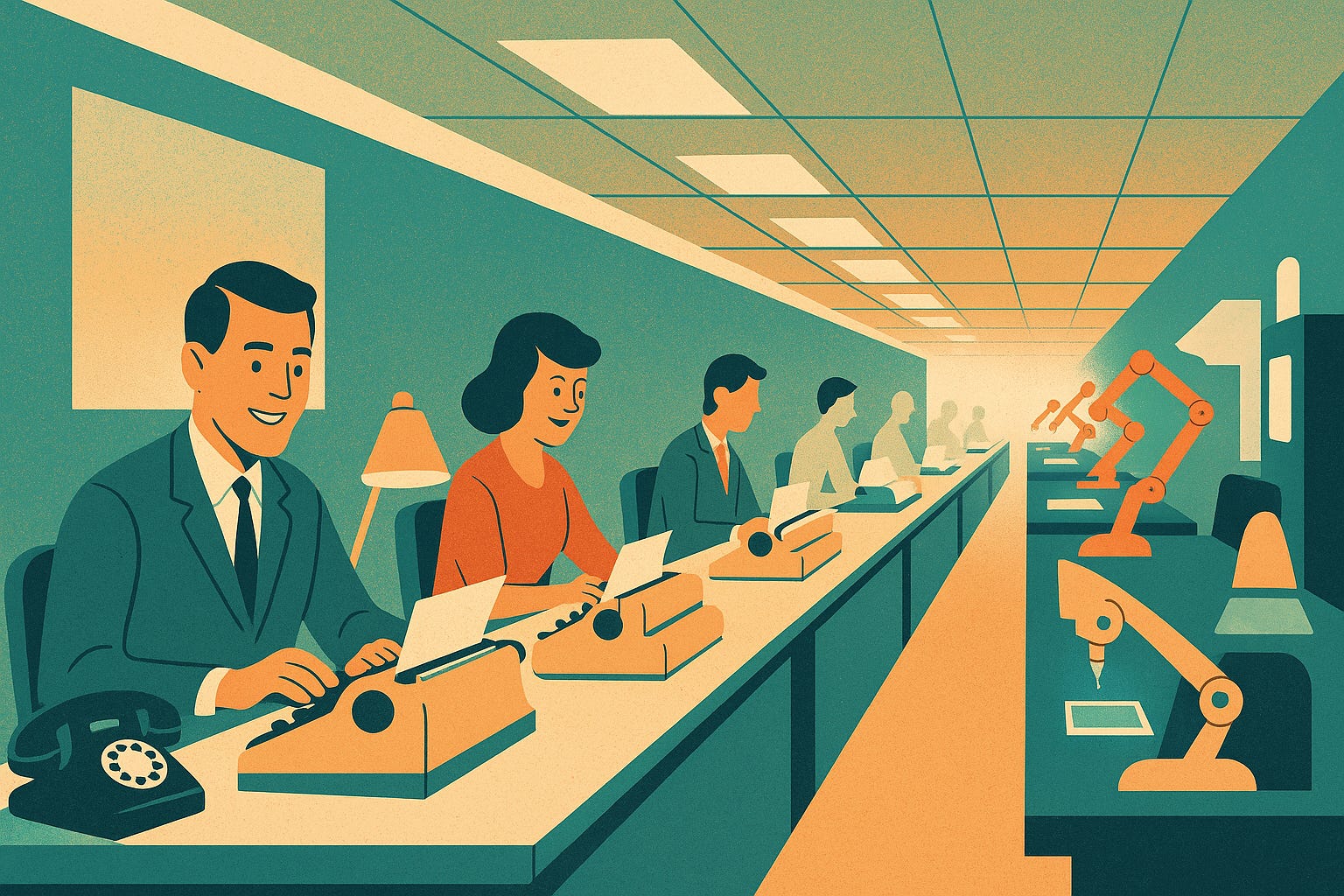
The problem isn’t the technology.
Left unguided, automation follows gravity — toward consolidation, cost reduction, and the quiet erosion of its own audience. Guided with intent, it can still do what Walt meant it to do: carry the weight so people can carry the meaning.
What’s different now is who holds the tools.
For the first time, automation isn’t locked behind corporations and capital. The machinery is no longer hidden inside studios, factories, or boardrooms.
Ordinary people can touch it.
The abstractions are thinning. The systems are learnable. You don’t need permission to design work that removes drudgery instead of removing people.
But that also means the responsibility has shifted.
If automation erases dignity now, it isn’t because it had to.
It’s because someone chose not to learn how to wield it with care.
Learning these systems isn’t technical ambition anymore.
It’s literacy.
If you don’t understand the tools shaping work, someone else will decide what they’re for — and they will optimize for outcomes, not humans.
That’s not a future imposed on us.
It’s one we opt into by disengaging.
When I hear that song now — “There’s a great big beautiful tomorrow, shining at the end of every day” — it doesn’t sound naïve to me. It sounds like a design constraint.
A reminder that progress doesn’t justify itself.
It has to be aimed.
Automation will keep advancing whether we participate or not. The only real choice left is whether we learn enough to guide it — or leave the compass to people who only measure cost.
Walt didn’t build machines because he trusted technology.
He built them because he trusted people — if they were given back their time.
That’s still the bet.
And it’s one worth learning how to make again.
Not sure how AI actually fits into your business?
We offer a focused AI business readiness consultation to evaluate where AI can safely create leverage — and where it’s more likely to introduce risk or noise.
Normally a $500 engagement.
Currently offered at $250.
→ Get the AI Business Readiness Consultation